
| Other Names | Durgang |
| Climate/Terrain | Desert |
| Frequency | Uncommon |
| Organization | Group |
| Activity Cycle | Any |
| Diet | Carnivore |
These ugly carnivores are vaguely canine-like quadrupeds. The creature is roughly the size and shape of a powerfully built dog. However, it has a thick, hairless and horny hide with numerous bone protrusion. Covering much of the body is a form of organic plating - much like a crab's shell. The creature has thick heavy claws on all four feet. A number of short, spikes protrude from the shell along the spine. The feet are broad with splayed claws that allow it to run across sand without sinking in. The head of the creature consists of a large smooth shell which ends in a powerful beak. The creature has no eyes, nose or other sensory organs. The beak-like maw is edged with sharp bony ridges.
The creature stands one meter tall (3 ft) at the shoulder and weighs about 70 kilograms (150 pounds). The tail ends in a short, spade shaped blade.
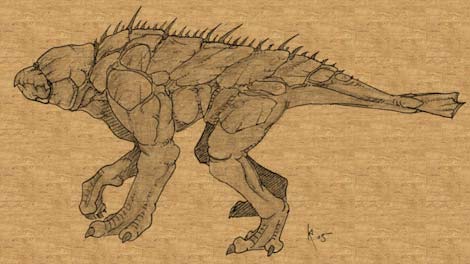
Sandrunners hunt in packs. These creatures have no eyes whatsoever. They hunt by motion, vibration and sound. Scholars think the entire cranial dome picks up motion and sound. Invisibility is useless against them. They can sense motion over long distances and have extremely good hearing. Scholars belief that the short spikes along the spine sense the tiniest variations in air currents.
Using the spade shaped tail as a shovel, the creature is able to rapidly bury itself in the sand. It is often able to surprise prey in this way.
These things live in the desert and wastelands. They are quite common in the arid regions of Qeshir, especially the Great Ahtabi Desert. But they can also be found in other desert regions around the world.
Something of a biological oddity, durgangs lay eggs in small clutches although it is a warm blooded creature.
To scholars, the creature is known as the "durgang" which is an ancient Traxxian word which translates as "desert devil".

This website was last updated August 29, 2026. Copyright 1990-2026 David M. Roomes.