
Hezra takes the characters to the edge of the stone quarry.
There is a set of huge stone stairs going down the side of the quarry wall to the quarry floor below.
Any spell casters in the group start to get a headache as they approach. (This is a side effect of the anti-magic field around Death’s Door. Anyone with memorized spells will get a headache). The headaches get stronger as they descend down into the quarry and approach the building.
Any methkari crystals that the group has will start to "sing". As they get closer to Death's Door, the crystals start to sing louder, then buzz discordantly and finally they shatter completely. The magical emanations here are too strong and simply overload the crystals. Any sort of magic item or spell that detects magic will also be overloaded and will simply not work.
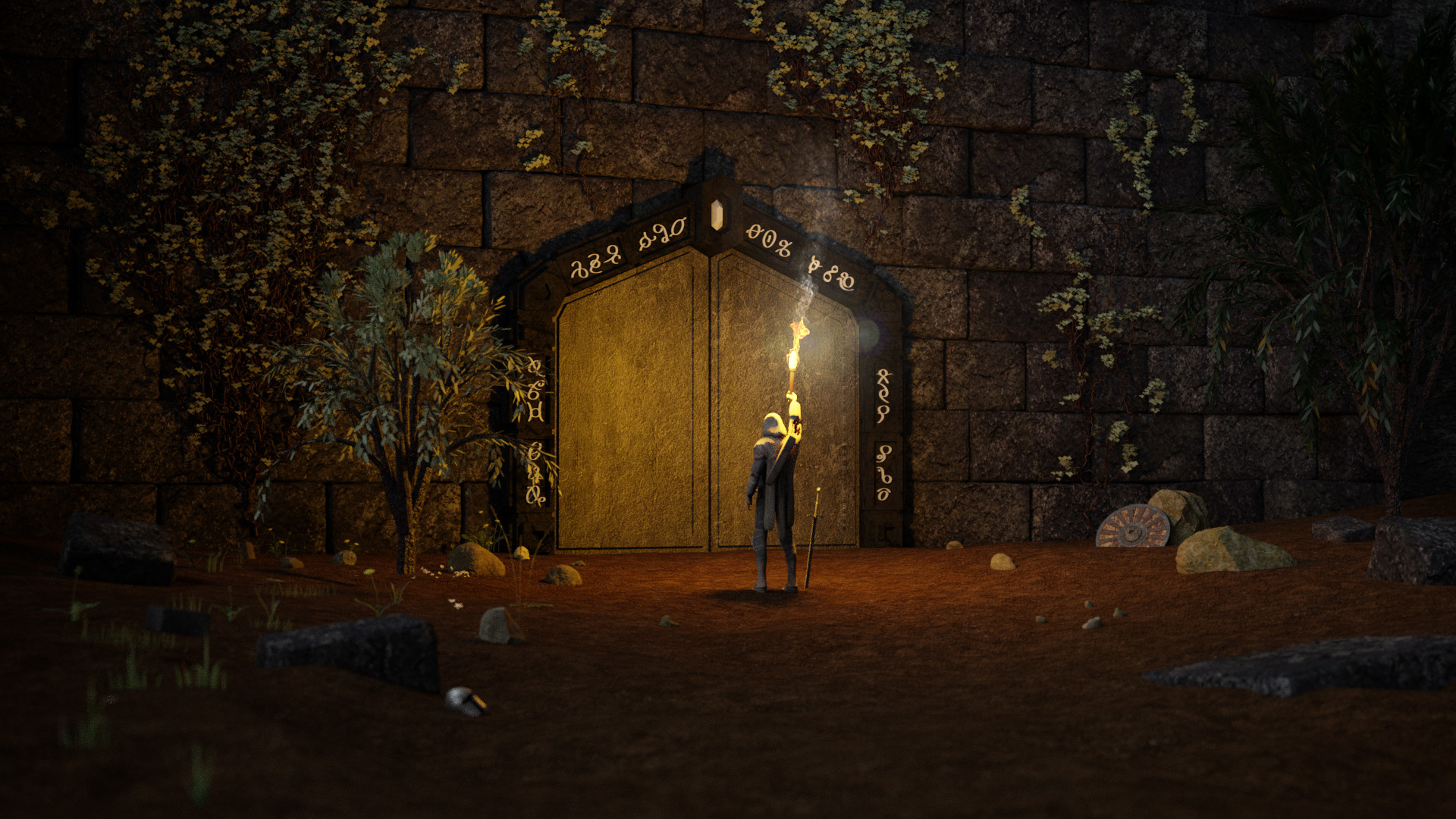
As the characters travel across the floor of the quarry, they get their first good look at Death's Door. It is a massive iron door in the side of the side of the far wall of the quarry.
At about 300 feet from the structure, the headaches of the spell casters become truly incapacitating. Spellcasters begin to vomit and shake and get weak. If they are to be brought closer, they must be carried. And they will refuse to go closer. They feel like they are dying.
Non-spell casters can approach Death's Door with no ill effects.
Death's Door is truly an impressive sight. The side of the far wall of the quarry is chiseled and shaped into the face of a massive building. The door itself is a massive iron thing. Surrounding it are thousands of tiles, each bearing a glyph of power. These glyphs glow quietly.
These glyphs impart great strength to the building and generate an anti-magic field around the building. No foreign spells will work in the quarry. None at all.
Non spell casters may approach Death's Door. If one of them touches any part of the Key to Death's Door, the glyphs will "shut off", ceasing to glow and the anti-magic field here will dissipate. The Door will then slowly open. The Door has a left and right side which slow slide apart with the heavy mechanical grinding of ancient gears and wheels. With a heavy grinding sound, Death’s Door which has been closed for centuries, slowly yawns opens.The stench of death and decay rolls out.
Now that the glyphs are turned off, spell casters may approach without feeling ill.
The chamber just inside Death's Door beyond is dark. When the characters enter, they will find the "Great Chamber". According to everything they have heard, this chamber was the last futile stand against monsters coming up from the darkness underground. Here was played out that final battle.
The aftermath of that battle still lies here. The Great Chamber is filled with skeletons. This huge chamber has a large shaft at its center. Built behind the shaft is a great altar. The Shidarans built a shrine there to bless the ground and stop the "Curse". The priests of the time thought that it would help to appease their gods. It did not have the intended effect. And so the city built Death’s Door to seal the shaft forever.
There is an ancient and rotted set of wooden stairs that circles down the shaft into the darkness. The shaft is 20 feet across and 80 feet deep.
It will take the party a few minutes to explore this chamber. Before they descend down into the shaft, they are attacked. The eighteen skeletons begin to move. They hoist themselves up on their bony limbs, pick up their rusted blades and advance on the group. These skeletons are not normal skeletons. They are much tougher than expected. They are being driven by some terrible force of will, some evil that plagues this place. They "heal" their wounds and the mere presence of them causes a fear effect. Feel free to play up these skeletons and make them as tough as you want. They are, however, still just undead.
Ultimately the party should be able to defeat them because something even tougher is coming up the shaft. Just as the party is beginning to win against the skeletons, they hear something big crashing around underground. They hear it coming up the shaft. A great tentacled reptilian thing comes clawing its way up the side of the shaft, destroying the wooden staircase as it comes.
This thing looks vaguely like some giant lizard or frog. In place of a head, it has four large scaled tentacles.
These four tentacles lashed out at the party. Although the party was doing well against the undead creatures, this new enemy is much more dangerous. It’s thick reptilian skin turned blades easily. Despite doing lots of damage, it just keeps coming. This creature has the ability to swallow whole. Any victim that it gets a good grip of with one of the tentacles will be swallowed whole on the next round.
If you want to make things even more challenging, you could have the ancient wooden staircase get damaged or destroyed during the battle. Or perhaps the body of the monster falls back down the shaft and takes out the entire staircase. That gives the party quite a challenge on how to get down the shaft.
Eventually, the party will defeat this monster too, but it should be a tougher fight. When this creature dies, it turns into a protoplasmic gel of reddish color which begins to crystallize. Anyone who knows anything about the morphians will recognize that this is what happens to a morphian when it dies. This thing was a morphian. Or, at least, it was partially a morphian or perhaps at one time it was.
In actually, this is a spawn of the Godbeast that waits below. If you remember from the introductory notes, the Godbeast is what resulted from the merging of all the morphians long ago when Aracles experiments went horribly wrong. When Aracles failed to control the magic of the Jaidor Talisman, he accidentally merged all the morphians, including himself, into a horrific monstrosity we shall call the Godbeast. It is far below at the center of a great maze and it has spawned many mutated creations... this was the first of many that the party will encounter before they reach the final battle.

This website was last updated August 29, 2026. Copyright 1990-2026 David M. Roomes.